ORCID ID: https://orcid.org/0009-0008-4006-0741
EDITED VOLUMES
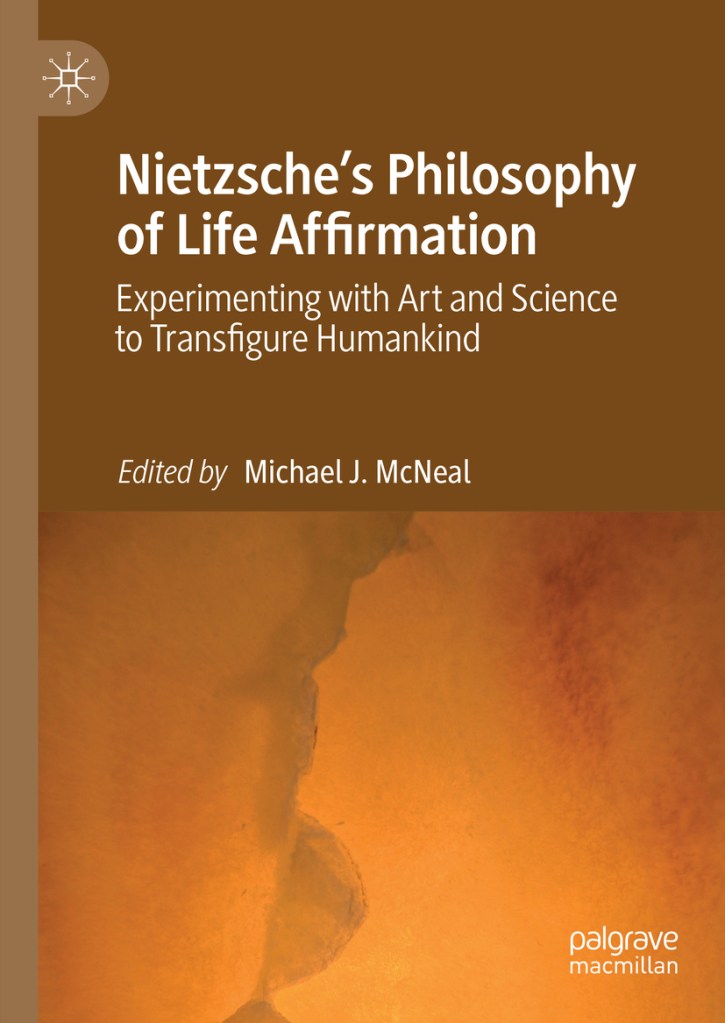
Nietzsche’s Philosophy of Life Affirmation: Experimenting with Art and Science to Transfigure Humankind
Michael J. McNeal, editor, Palgrave MacMillan, 2024.
https://doi.org/10.1007/978-3-031-71690-4
Featuring essays by Glen Baier (University of the Fraser Valley), Dylan S. Bailey (University of South Florida through the Yale Center of Faith and Culture), Stephen Cheung (Durham University), Pieter De Corte (Yale University, through the European Studies Council and the Belgian-American Educational Foundation), Jessica S. Elkayam (Sam Houston State University), Robert E. Guay (Binghamton University, SUNY), Kathia Hanza (Pontificia Universidad Católica del Perú), Fraser Logan (Warwick University), Jozef Majerník (Institute of Philosophy of the Slovak Academy of Sciences), Jill Marsden (University of Bolton), Katrina Mitcheson (The University of the West of England), and Pedro Nagem de Souza (University of Campinas), with an introduction by Michael J. McNeal.
This anthology broadly examines the interrelated roles of art, science, and experimentation in Nietzsche’s philosophical project. It is divided into two parts, the first organized around the theme of experimentally reconceiving our world, the second investigating the aforementioned subjects in Nietzsche’s “free spirit” or “middle period” works. Together, the essays comprising the book underscore Nietzsche’s concern that experimentation with values ultimately provide humankind with a new “wherefore” or purpose. Wide-ranging in its scope, this volume brings together a diverse group of scholars working in both the analytic and continental traditions to provide original insights into Nietzsche’s thought. A unique contribution to the scholarship, it will deepen understanding of the relationship between Nietzsche’s critiques of art and science, the role this relationship plays in his futural thought, and the experimental, life-affirming practices that his free spirit project may enable toward the transfiguration of humankind.
Nietzsche on Women and the Eternal-Feminine: A Critique of Truth and Values
Michael J. McNeal, editor, Bloomsbury Academic, 2023.

ISBN: 978-1350345287
Featuring essays by Katie Brennan (Salve Regina University), Marina García-Granero (Universitat de València), Lawrence J. Hatab (Professor Emeritus, Old Dominion University), Shruti Jain (O. P. Jindal Global University), Nicholas Low (Harvard University), Marisa E. Maccaro (Reedley College), Allison Merrick (California State University, San Marcos), Mat Messerschmidt (University of Chicago), Kelly Oliver (Vanderbilt University), Isadora Petry (University of Campinas), Justin Remhof (Old Dominion University), Pedro Nagem de Souza (University of Campinas), Lorenzo Serini (University of Warwick), Vinicius Souza de Paulo (Federal University of São Paulo), and Marta Vero (The Italian Institute of German Studies, Rome), with an introduction by Michael J. McNeal.
By re-examining Nietzsche’s notion of the “eternal-feminine” and his views on women and feminism, this volume offers new perspectives on some of his key ideas. It brings together a diverse group of scholars to critically engage with Nietzsche’s use of late-19th-century gender stereotypes and the ways in which they served his critique of values, including his use of “woman” as a trope for truth.
Among other subjects, the contributors consider the role of psychology in Nietzsche’s thought, his concern with style, self-creation, and advocacy of perfectionism, his views on romantic love and marriage, and his aim of revaluing all values to instigate a distant philosophy of the future. They investigate parallels between Nietzsche’s thought and Shaktism, his relation to Goethe and Stendahl, and his influence on Beauvoir, Butler, and Dohm. With the inclusion of two seminal essays on Nietzsche and women by Lawrence J. Hatab and Kelly Oliver, the anthology also illustrates some of the ways in which scholarship on these subjects has evolved over the last four decades.
Providing fresh insights into these interrelated subjects, Nietzsche on Women and the Eternal-Feminine highlights the enduring relevance of his thought and its still-underappreciated potential for re-thinking both the bases for and aims of feminism and other emancipatory movements.
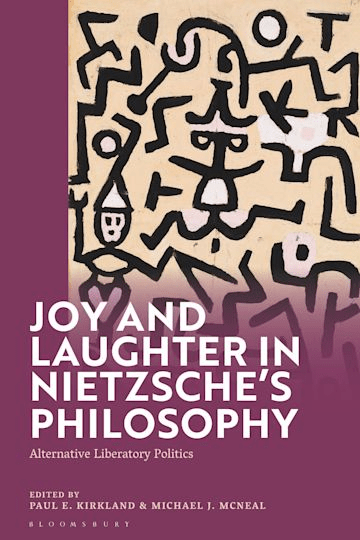
Joy and Laughter in Nietzsche’s Philosophy: Alternative Liberatory Politics
Paul E. Kirkland and Michael J. McNeal, eds., Bloomsbury Academic, 2022.
ISBN: 978-1350225275
Featuring essays by Ruth Abbey (Swinburne University of Technology), Glen Baier (University of the Fraser Valley), Jeffrey Church (University of Houston), Katia Hay (University of Amsterdam), Paul E. Kirkland (Carthage College), Richard J. Elliott (Birkbeck College), Peter S. Groff (Bucknell University), Michael J. McNeal (University of Denver), Philip Mills (University of Lausanne), Jamie Parr (University of Southern Queensland), and Melanie Shepherd (Misericordia University), with an introduction by Paul E. Kirkland and Michael J. McNeal.
Analyzing the importance of joy, laughter, and cheerfulness in Nietzsche’s thought, this anthology addresses an under-examined topic in the secondary literature. By exploring disparate aspects of these interrelated emotions it provides new insights into his key ideas.
The volume’s contributors–among them philosophers and political scientists–illustrate the significance of these feelings to reveal political ramifications of their affirmative potential and their broader role in Nietzsche’s philosophical aims. These include how the joyful disposition Nietzsche commends informs his free spirit’s self-overcoming, attempts to revalue all values, and prospects of ultimately transfiguring humanity.
Among other topics, scholars assess the Übermensch and shared joy, learning to laugh at oneself, Schopenhauer’s jokes, Pascal’s cheerfulness, and the Dada movement’s subversively playful aesthetic. By contemplating Nietzsche’s emphasis on joy and laughter, the volume reveals a thinker who, far from being a caricature of hopeless nihilism, is in fact the hitherto unrecognized champion of an alternative liberatory politics.
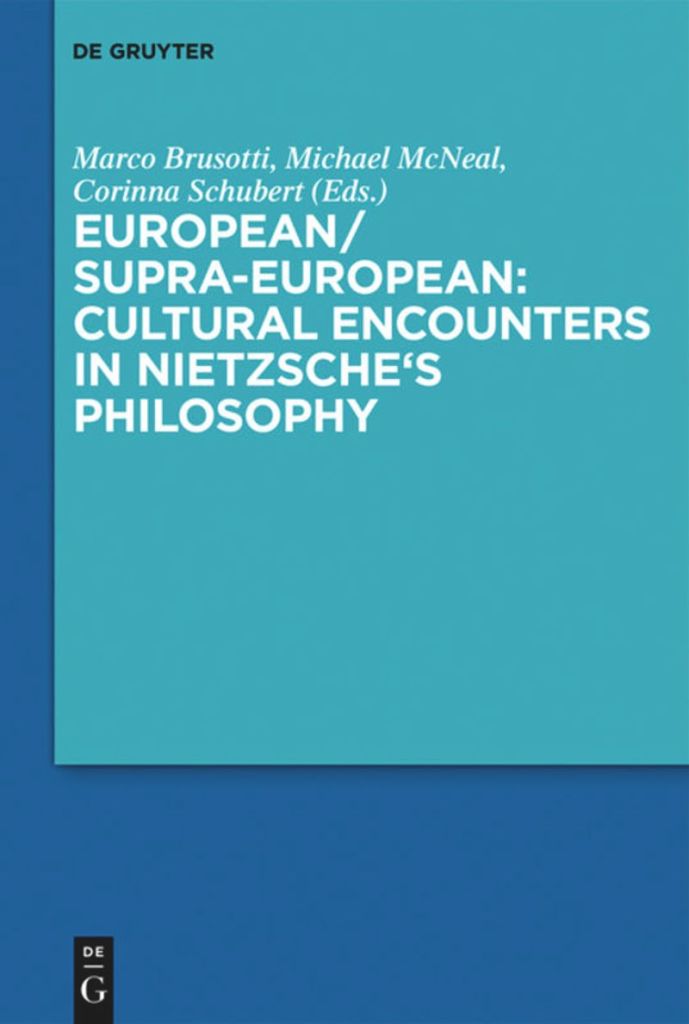
European/Supra-European: Cultural Encounters in Nietzsche’s Philosophy
Marco Brusotti, Michael McNeal, Corinna Schubert, and Herman Siemens, eds.,
Walter De Gruyter, 2020.
https://www.degruyterbrill.com/document/doi/10.1515/9783110606478/html
ISBN: 978-3110605044
A bi-lingual volume featuring 13 essays in English (Michael J. McNeal, editor) and 10 essays in German (Corinna Schubert, editor) from a multinational group of philosophers at various career stages, with an introduction by Marco Brusotti (Università del Salento), and assistance from Herman Siemens (Universiteit Leiden).
In my own chapter contribution to this volume, ‘Good Europeanism: The Practice and Pathos of Nietzsche’s Good Europeans’, I consider how Nietzsche’s ‘good Europeans’ come to embody his “free-spiritedness” by instinctively enacting agonic practices (contests and striving) and the skeptical disposition necessary for the eventual overcoming of Europe’s nihilism. I show how Nietzsche expected the aforementioned practices to arise from the free spirit’s passions (or páthos, in the Greek sense of undergoing struggle), expressed through their attempts to become ‘good Europeans’, and how in doing so they would foster the orientation and corresponding mood characteristic of good Europeanism. Transforming them physiologically and attitudinally, this life-affirming orientation would inure them to the spiritual narcotization of romanticism, nationalism, and xenophobia. I argue that as ‘good Europeans’ Nietzsche expected them to counter myopic statism, create inclusive new values, and generate culturally reinvigorating forms of life. Finally, I demonstrate the contemporary relevance of Nietzsche’s pluralistic value orientation – his ‘good Europeanism’ – via its potential for facilitating recuperation from the bad conscience that impairs the modern European project and distantly realizing Nietzsche’s cosmopolitan idea of Europe.
US Approaches to the Arab Uprisings: International Relations and Democracy Promotion
Michael J. McNeal and Amentahru Wahlrab, eds., I.B. Taurus, 2018.

ISBN: 978-1784536077
Featuring essays by Michaelle Browers (Wake Forest University), Anthony R. DiMaggio (Lehigh University), Eric Fattor (Colorado State University), Nicholas A. Jackson (Independent Scholar), Isaac Kamola (Trinity College), Michael J. McNeal (University of Denver), Meghana Nayak (Pace University), Larbi Sadiki (Middle East Council on Global Affairs), Layla Saleh (University of Wisconsin-Milwaukee), and Amentahru Wahlrab (University of Texas, Tyler), with an introduction by Michael J. McNeal and Amentahru Wahlrab.
From nonviolent protests in Cairo and Manama to the ousting of Libya’s Gaddafi and the beginning of the Syrian Civil War, the series of uprisings which swept through the Middle East and North Africa from late 2010 have been burdened with the collective hopes and expectations of the world. Western supporters quickly identified these uprisings as a collective ‘awakening’ – a move towards democracy – but the continued unrest in these regions defies many of these more optimistic contemporary predictions. As the region remains unstable, the US and their Western allies are faced with the challenging task of modifying their strategic foreign policy goals to suit the currently mercurial Arab World. The ‘Arab Spring’ and its failure exposed a new set of questions: What motivates American ‘democracy promotion’? Does the US really want self-determination in the Middle-East and North Africa? Where did the expectations of the protestors fit into this narrative? U.S. Approaches to the Arab Uprisings provides a comprehensive assessment of Western foreign policy towards the Arab World today.
With analysis on subjects as diverse as social media and Islamic centrism, and drawing from examples throughout the MENA region, the book deals with the perception of Arabs and Arab culture in the American psyche and its effect on East-West relations. By analyzing both Western responses to uprisings and the reactions of the protestors themselves, the contributors expose theoretical and practical inconsistencies that suggest a rising tension between those that promote democracy and those who practice it.
CHAPTER CONTRIBUTIONS TO SCHOLARLY ANTHOLOGIES
‘On the Unconventional Sociality of Free Spirits: New Communities to Transfigure Humanity’, in Nietzsches Perspektiven des Politischen (Nietzsche’s Perspectives on the Political), Martin A. Ruehl and Corinna Schubert, eds., Walter De Gruyter, 2023.

Chapter abstract:
This chapter challenges the widely held view that Nietzsche advocated the primacy of the individual over-above community. I argue that far from being an individualist in any usual sense, Nietzsche suggested a new conception of community–one comprised of free spirits leading a people–which he expected to play a crucial role in the more distant transfiguration of humanity. The goal of creating new (re-naturalized) foundations for community informs Nietzsche’s rejection of the hegemonic (‘herd’-dominated) forms of social organization throughout Europe in his day and our own. But what drives free-spirited individuals to come together in novel forms of community? This question leads us to consider the unconventional sociality of free spirits, who in striving to overcome and perfect themselves come together in unconventional “communities”. It is from their mutually edifying contests and the tests of mettle they undertake that their shared admiration and sense of camaraderie arises. In part through their provocative struggles, Nietzsche expected them to promulgate values beyond good and evil and revitalize humanity. Yet given that he refrained from prescribing specific institutional reforms or social arrangements (his admiration of classical Greek aristocracy notwithstanding), I consider the viability of the agonistic form of sociality Nietzsche advanced and the life-affirming communities they might generate.
‘The Quandary of Identity and the Prospective Appearance of Free Spirits in our Globalising Age’, in Nietzsche and the Politics of Difference, Andrea Rehberg and Ashley Woodward, eds., Walter De Gruyter, 2022.

Chapter abstract:
Nietzsche’s related analyses of culture and identity permit an incisive assessment of the décadence characteristic of neoliberal globalisation, the hegemonic ideology of our age. Taking up Nietzsche’s assessment of the quandary of identity and the prospects for the appearance of individuals, both of which were conditioned by his critique of décadence, I consider his view that identity becomes problematic when degenerating values fail to affirm a society’s cultural norms and enforce its rank order of difference. Developing Nietzsche’s appraisal via the insights of Debord and Baudrillard, I argue that such a critical analysis of culture can illuminate how liberal modernity destabilises traditional values and subverts identities through alienating, media-driven spectacles of multiculturalism. These banalise difference and autochthonous cultural values to promote simulated conceptions of selfhood. However, a Nietzschean form of jovial ironism may sufficiently invigorate prospective free spirits within disparate cultural milieus to facilitate their own — and their degenerating culture’s — overcoming.
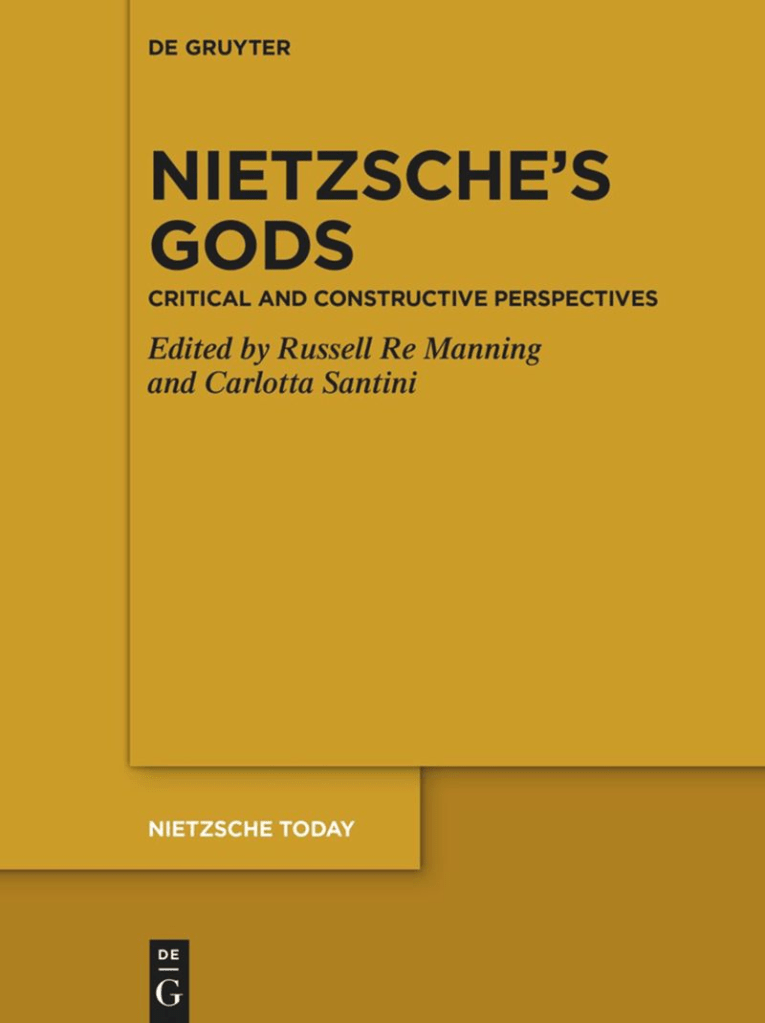
‘Life-Affirmation and Disgust with Humanity in the Wake of the Death of God’, in Nietzsche’s Gods, Critical and Constructive Perspectives, Russell Re Manning and Carlotta Santini, eds., Walter De Gruyter, 2022.
Chapter abstract:
In the wake of the death of God, Nietzsche was concerned with the disgust or nausea induced by the nihilism he considered symptomatic of the degeneration of humankind and the sickening effects it might have on the healthiest, most spiritual individuals. However, I maintain that disgust (an emotion Nietzsche himself often conveys in his works) counterintuitively facilitates the self-overcoming of free-spirits, as well as their striving to hasten the de-deification of the natural world and with it their own (and humanity’s) down-going. Nietzsche recognized that Christianity’s disdain for life had killed the very God it venerated, and that the universalization of secular values (the ascetic-ideals animating “scientific atheism”) was further diminishing life. Yet the disgust Nietzsche’s free spirits feel for decadent humanity differs essentially from Christianity’s life-denying spirit of revenge. I argue that the former’s disgust is crucial for healthy individuals in that it impels them to pursue regimes of self-creation and perfection that increase the pathos of distance between themselves and others. By overcoming their disgust with humankind’s degeneration, they may experiment with values to accelerate the down-going of “the species man” and inaugurate a post-human(ist) future thereby.
‘Nietzsche Con/tra Epicurus: The Necessity of Noble Suffering for Intoxication with Life’, in Nietzsche and Epicurus, Vinod Acharya and Ryan Johnson, eds., Bloomsbury Academic, 2020.

Chapter abstract:
In this essay I examine how the resonances between Epicurus’s way of life and Nietzsche’s middle works are at odds with aspects of the latter’s mature thought. Synthesizing the breadth of recent scholarship on this issue, I track Nietzsche’s changing relationship with Epicurus as reflected across his corpus. I show that although Nietzsche eventually replaces Epicurus’s ethics of self-care as ataraxia with noble struggle and the agonistic striving for distinction, his fondness for Epicureanism persisted through his late works.
‘Nietzsche on the Pleasure of the Agon and Enticements to War’, in Conflict and Contest in Nietzsche’s Philosophy, Herman Siemens and James Pearson, eds., Bloomsbury Academic, 2018.
Chapter abstract:
In this essay I situate Nietzsche’s qualified celebration of war (including both conventional warfare and myriad forms of contestation and conflict) and recurrent use of martial imagery in the context of his project to renaturalize the human by promoting life-affirming pleasures and joyfulness in existence. While he criticized conventional warfare and the intellectual impoverishment engendered by great politics in his middle works, his post-Zarathustra works Nietzsche connected the pleasure (or displeasure) elicited by experiences of cruelty and war with health, the response of individuals to those experiences indicating their spiritual rank order. I further examine the contrast Nietzsche draws between pleasure and joy and displeasure/ressentiment in connection with the need to combat the nihilistic-ascetic denial of the drives that impel becoming. Nietzsche opposes modernity’s debasement of man and war on the passions, which fosters the nihilistic desire for security, equality, peace, and the abolition of suffering. Conversely, war increases the strength of individuals and peoples, ergo–as I argue–Nietzsche’s “war” on liberal-modernity. I conclude that for Nietzsche happiness grows through difficulties (conflicts and contests) overcome, and that pleasure is dependent upon the struggles one undertakes in overcoming resistances.
 Dr. Michael J. McNeal